

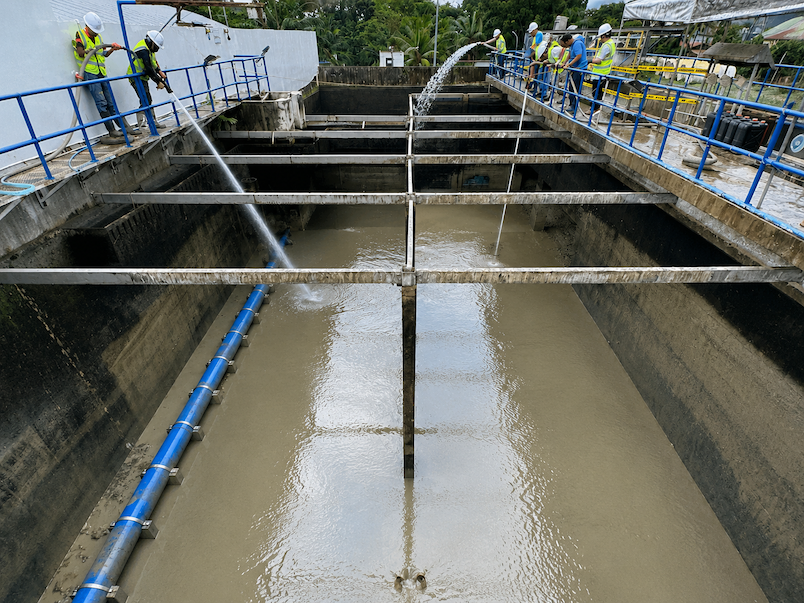
MPBW personnel conduct maintenance and cleaning of the raw water tank at Water Treatment Plant 2, removing accumulated sludge to improve water flow through the facility’s filters and help increase water production.
Metro Pacific Water (MPW), operating in San Jose del Monte through Metro Pacific Bulacan Water (MPBW), has restored water production at Water Treatment Plant 2 (WTP2) to its 30 million liters per day (MLD) design capacity following the completion of raw water tank cleaning on August 7, 2026. The additional 10 MLD was fully restored by August 8, 2026, after accumulated sludge had significantly reduced the tank’s usable capacity.
WTP2, which was designed to produce 30 MLD but is currently being operated at levels reaching 40 MLD, saw treated water production decline to around 20 MLD amid accumulated sludge and maintenance issues. Following the cleaning works, MPBW restored production to as much as 30 MLD, recovering 10 MLD of treated water capacity for distribution to approximately 10,000 households in the higher-elevation areas of Mulawin, Guijo, Yakal, Narra, Poblacion, Poblacion 1, Sto. Cristo, Minuyan 1, Minuyan 2, Minuyan 3, Minuyan 4, and Minuyan 5.
“This is an important improvement, but it also shows the scale of the work ahead of us. We cannot solve San Jose del Monte’s water problems overnight. Years of stopgap measures and deferred maintenance contributed to the condition of the system we inherited. We need to rehabilitate the treatment plants while simultaneously fixing the distribution network so that the water we produce can actually reach San Joseños,” said Engr. Roldan Pineda, Chief Operating Officer of MPBW.
The raw water tank had last been cleaned in December 2024, before MPBW began interim operations in June 2026. Facilities of this type are recommended to be cleaned at least twice a year to prevent sludge buildup from reducing their storage and treatment capacity.
MPBW is also addressing treatment constraints caused by increasingly challenging raw water conditions from Angat Dam. High levels of turbidity and manganese require additional treatment and operational adjustments because the existing plants were not originally designed to handle these conditions at current levels.
“We learned that in the past that the previous operator would simply stop the production when raw water conditions became difficult. Our approach is to keep the plant operating safely and consistently by improving treatment processes and rehabilitating critical equipment. The goal is not simply to produce more water, but to make sure the water remains compliant and can be distributed reliably,” Engr. Pineda added.
Despite recovering an additional 10 MLD, some areas in higher elevation may continue to experience low pressure or intermittent supply because the total water available to the system remains insufficient to meet overall demand. When multiple communities draw water simultaneously, available pressure drops further, particularly in higher-elevation areas.
“This is why treatment facilities, the distribution network and available water sources all have to be improved together. That rehabilitation takes time, but we are working on these areas simultaneously,” Engr. Pineda said.
Alongside improvements at WTP2, MPBW has repaired more than 400 pipeline leaks in nine weeks, reducing water losses from damaged lines and helping more of the available supply reach consumers. MPBW is also advancing the Phase I Tanawin Reservoir-to-Igay Reservoir Transmission Project, targeted for completion by December 2026, to strengthen water delivery capacity and improve supply reliability across the network.
About the Author